15 November 2026
What an OpenAI Compatible API Actually Standardizes
Presented by @thepromptstack
When developers talk about a unified AI API, they usually mean an interface that lets you send the same request shape to different large language models and get back a response that looks the same. The most common reference point is the OpenAI API format. Many providers, including those that resell model access or offer competing sellers, advertise their service as OpenAI compatible. But compatibility covers a specific set of conventions, and it leaves many things deliberately unspecified. Understanding the boundary helps you decide whether a given unified API saves you work or hides the differences you need to manage yourself.
The Core Standard: Request and Response Shape
An OpenAI compatible API standardizes the transport layer. You send a REST request to a base URL that expects a POST method, with an API key passed in an authorization header. The request body follows a JSON schema that includes fields such as "model", "messages", "temperature", and "max_tokens". The response returns a JSON object containing an "id", "object", "created" timestamp, "model" identifier, and a "choices" array where each choice holds a "message" object with a "role" and "content" string.
This shape is the main reason developers adopt a unified API. If you have already written code against the OpenAI Python SDK or JavaScript library, switching to another provider that mimics the same request schema means you only change the base URL and the API key. Your existing message formatting, tool call structures, and streaming logic continue to work. That is a real time saving.
But the standard only goes so far. It does not say which model identifiers are valid. It does not guarantee that the same model name returns the same behavior. It does not define how the API handles rate limits, error codes, or content moderation. These details are left to each implementation.
What Is Not Standardized
Model Identifiers and Availability
The model identifier field is part of the request schema, but the set of valid identifiers depends entirely on the provider. One service might map "gpt-4o" to the actual OpenAI model, while another might route it to a different model entirely. Some providers offer custom identifiers that do not exist in OpenAI at all. A unified API that connects multiple sellers must decide whether to pass through the original model names or map them to internal keys. You cannot assume that a model name works the same way across different endpoints.
Capability Differences
OpenAI compatible APIs standardize the message format but not the underlying model capabilities. One model might support tool calls, structured outputs, or image inputs. Another model behind the same API wrapper might ignore those fields or return an error. The request schema accepts optional parameters such as "tools" or "response_format", but the API does not tell you which models support them until you send a request. Some providers document this per model; others leave you to discover it through trial and error.
Pricing and Cost Models
The response format includes a "usage" object with token counts, but it does not include pricing. Two providers using the same API shape may charge very different rates per token. A unified API that aggregates multiple sellers may offer prices below the list rates of the original providers, but the request and response formats give no indication of cost. You have to check the provider's own documentation or pricing endpoint to understand what you will be charged.
Rate Limits and Error Handling
OpenAI uses specific HTTP status codes and error shapes. A compatible API may return the same "429 Too Many Requests" code, but the rate limit windows, retry headers, and quota exhaustion behavior can differ. Some implementations return custom error codes in the body that do not match the OpenAI specification. If your code relies on parsing error messages or headers, you may need to handle provider-specific cases.
Why the Distinction Matters
The promise of a unified API is that you write code once and it works everywhere. That promise holds for the basic request and response shape. You can swap the base URL and the API key, and your message formatting, streaming, and token counting logic remains correct. This is a real advantage when you want to test multiple models quickly or when you want to avoid vendor lock-in.
But the promise breaks down if your application depends on features that are not part of the core standard. If you need guaranteed support for tool calls, a specific response format, or a consistent error handling pattern, you cannot rely on the API compatibility alone. You need to know which models behind the unified API support those features.
A good unified API documents these differences transparently. It tells you which model identifiers map to which actual models, which optional parameters each model supports, and which pricing applies to each. The API wrapper itself does not standardize these things; the provider's documentation and service design do.
How Developers Work Around the Gaps
Experienced teams approach a unified API as a convenience layer, not a contract. They keep their code modular so that changing the backend does not require rewriting the entire application. They test each model they intend to use, not just the API endpoint. They build fallback logic that handles cases where a model does not support a requested feature.
A common pattern is to use the unified API for prototyping and comparison, then pin a specific provider and model for production. The unified API handles the initial integration; the team later optimizes for cost, latency, or feature coverage by choosing a single seller. This approach gives you the flexibility of a unified API without assuming that all endpoints behave identically.
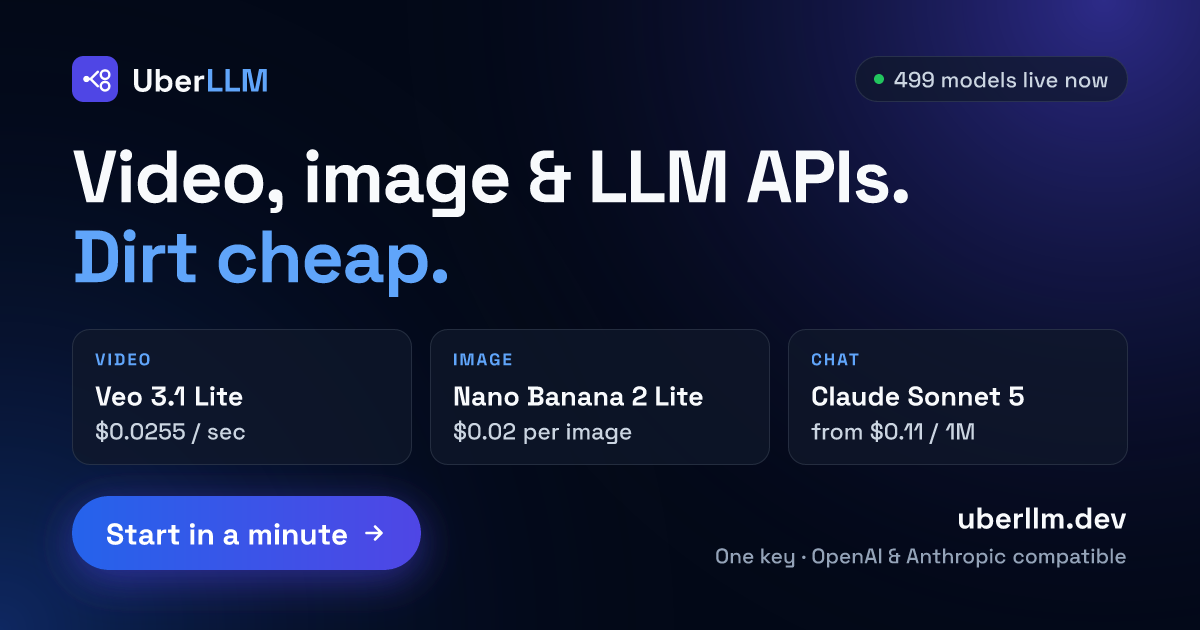
Some providers, such as uberllm.dev, offer a single endpoint that connects to multiple competing sellers. The API follows the OpenAI request schema and response format. You send a standard request, and the service routes it to the seller offering the best price at that moment. The response looks the same regardless of which seller handled the request. This design preserves the convenience of a unified API while adding a layer of cost optimization.
When you use a service like uberllm.dev, you still need to verify that the models you rely on support the features you need. The API itself does not standardize capabilities or pricing. But the service does give you a single point of integration for multiple models and sellers, which reduces the overhead of managing separate accounts, API keys, and request formats.
What to Look For in a Unified API Provider
- Clear documentation of which model identifiers are available and what they map to.
- Explicit statements about which optional parameters each model supports.
- Transparent pricing information, either per request or per token.
- Consistent error codes and rate limit behavior, or documentation of deviations.
- Support for the same authentication and SDK patterns as the original OpenAI API.
These factors determine whether the unified API simplifies your workflow or adds another layer of complexity. The request and response format alone is not enough.
The Bottom Line
An OpenAI compatible API standardizes the transport and the JSON shape of requests and responses. It gives you a common interface for sending messages and reading results. It does not standardize model behavior, supported features, pricing, or error handling. Those are left to the provider.
If you treat the unified API as a thin compatibility layer and verify the model-specific details separately, you get the benefits of simpler integration and easier model switching. If you assume that compatibility means identical behavior, you risk surprises when a model does not support a feature you assumed was universal. The distinction is subtle but important, and it determines whether a unified API saves you time or costs you debugging hours.